Themes of Friendship and Loyalty in “Tag”
The film Tag, inspired by real events, presents a sustained exploration of friendship and loyalty through the story of five men who continue a childhood game of tag into adulthood. Rather than positioning the game as a mere comedic premise, the narrative uses it as a structural device to examine how long-term relationships can persist despite geographic distance, career demands, marriages, and personal change. The annual competition provides continuity in their lives, offering a framework through which these men reaffirm shared history and mutual commitment. Beneath the surface humor lies a consistent focus on how traditions reinforce relational bonds over time.
The film’s portrayal of friendship does not rest on sentimental expression. Instead, it highlights action: showing up, participating, and honoring a shared agreement. The game becomes a lived demonstration of loyalty, expressed through physical presence and sustained effort. Through this repeated ritual, the friends maintain alignment with earlier versions of themselves while adapting to the realities of adulthood.
Background of the Game
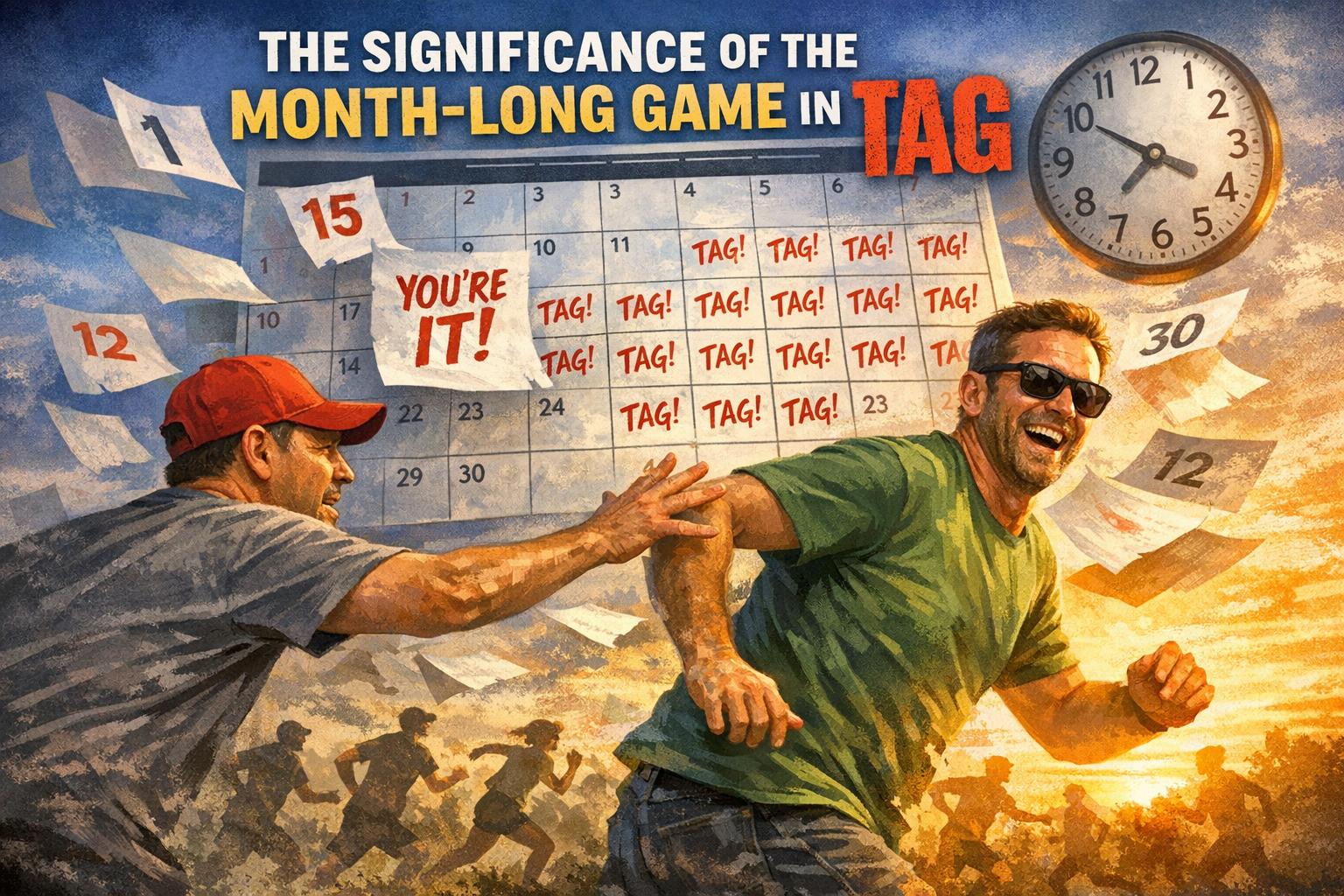
The story centers on a group of classmates who began playing tag in elementary school. What might typically have been a playground diversion evolves into a structured annual event occurring every May. Over the course of thirty years, the participants refine rules, coordinate schedules, and treat the game with a seriousness that contrasts with its apparent simplicity. The annual recurrence gives the tradition both predictability and purpose.
As the characters move into distinct adult roles—corporate executive, husband, father, fitness enthusiast, entrepreneur—the game continues unchanged in principle. This consistency becomes symbolically significant. While careers shift and personal priorities grow more complex, the core activity remains intact, serving as a shared constant in otherwise evolving lives. The tradition resists the fragmentation commonly associated with adulthood friendships. Distance, rather than dissolving the bond, becomes an obstacle to manage.
The film underscores that the persistence of the game is not accidental. It requires planning, travel, and negotiation with family obligations. The willingness to coordinate these efforts year after year transforms the game from spontaneous amusement into a deliberate act of relationship maintenance. In this way, the background of the game establishes the foundation for understanding loyalty not as passive affection but as practiced discipline.
Friendship Through Challenges
As adults, the characters face pressures that commonly disrupt long-term friendships. Professional demands create scheduling conflicts. Marriages introduce new relational priorities. Parenthood alters availability. Health concerns and personal insecurities further complicate sustained engagement. The film portrays these developments without dramatizing them excessively, presenting them as natural progressions in adult life.
Despite these changes, the game functions as an anchor. Participation often requires compromise. Characters must negotiate with employers, coordinate with spouses, or adjust personal agendas to remain involved. These adjustments demonstrate that friendship, in this context, is not preserved by convenience. Rather, it survives because it is intentionally prioritized.
Commitment to friendship appears in practical decisions. Several characters travel significant distances to tag or evade one another during the designated month. Others conceal strategic moves or alter daily routines to protect their status in the game. While exaggerated for comedic effect, these behaviors symbolize a deeper readiness to invest time and effort in sustaining connection.
The narrative also shows tension within the group. Competition generates conflict, misunderstandings arise, and personal frustrations surface. However, the continuation of the game itself becomes a method for resolving strain. By adhering to the shared rules, the men reaffirm their mutual respect. Even rivalry operates within a mutually agreed structure, reinforcing trust rather than undermining it. The game provides boundaries that allow conflict to remain contained.
Through these dynamics, the film suggests that enduring friendships require not only shared history but also structured opportunities for interaction. Without intentional rituals, life’s transitions might gradually erode connection. The annual game becomes a recurring checkpoint that revives dormant interactions and strengthens relational continuity.
Loyalty in Maintaining Traditions
Loyalty in Tag manifests primarily through adherence to tradition. The yearly recurrence of the game is not enforced by external obligation; participation remains voluntary. Yet none of the core friends withdraw permanently. This sustained involvement conveys allegiance not simply to the activity itself but to the group identity it represents.
Traditions often serve as markers of belonging. In this case, the game defines membership within the group. To play is to affirm inclusion; to abstain would signal distance. Each character’s ongoing participation asserts loyalty to a shared identity formed in childhood. That identity, though transformed by age and responsibility, remains intact through ritual.
The film also explores loyalty by introducing a character who has never been “it.” His unbroken record becomes a motivating force for the others, intensifying their efforts. While this element adds comedic tension, it also illustrates how collective memory and shared ambitions reinforce solidarity. Even competition reinforces cohesion because it presupposes trust and familiarity.
In various moments, characters must choose between convenience and tradition. Attending social events, managing professional duties, or prioritizing family expectations might justify opting out. However, the recurring decision to participate demonstrates that loyalty involves intentional prioritization. It is not assumed but enacted.
Importantly, the film avoids portraying loyalty as blind adherence. There are moments of disagreement regarding the boundaries of gameplay and the appropriateness of certain tactics. These debates highlight that loyalty includes accountability. Friends question one another while remaining committed to the shared tradition. Through these exchanges, the narrative frames loyalty as active engagement rather than silent compliance.
The Importance of Shared Experiences
Shared experiences are central to sustaining the friendships depicted in Tag. The annual competition generates new stories, reinforcing existing bonds while expanding collective memory. Over decades, these experiences accumulate, becoming a reservoir of inside jokes, strategic narratives, and personal milestones.
Ritualized play offers a structured environment for interaction that might otherwise become sporadic. Instead of relying solely on informal communication, the group convenes through embodied participation. Physical movement—chasing, hiding, strategizing—distinguishes the experience from digital connection. The act of tagging and evading requires presence and attention, reinforcing interpersonal awareness.
Shared experiences also counterbalance divergence in life trajectories. As the characters grow apart in professional accomplishment or personal circumstance, the game places them on equal footing. Within its boundaries, corporate hierarchy and social status lose significance. The rules apply uniformly, reinforcing the egalitarian foundation of their early friendship.
Furthermore, the accumulation of memories across three decades demonstrates continuity. The friends reference prior years, recall past strategies, and integrate historical outcomes into present decisions. This layering of memory creates depth within the relationship. Each new installment of the game is informed by the entirety of previous interactions, strengthening the sense of enduring connection.
The film suggests that shared experience is not solely about enjoyment. It is also about continuity and identity. The annual ritual preserves elements of childhood within adult life, reminding participants of formative relationships. By revisiting this shared space regularly, the friends reinforce a consistent narrative of who they are together.
Although Tag emphasizes humor, the underlying structure illustrates a broader principle about sustaining long-term relationships. Friendships, particularly those originating in early life, often weaken without deliberate renewal. Rituals provide opportunities to reaffirm bonds. Loyalty emerges not only in moments of crisis but in ordinary acts of continuation.
The conclusion of the narrative reinforces these themes by acknowledging that life circumstances evolve. Change is inevitable, yet continuity remains possible through intentional practice. The annual game of tag, while seemingly trivial, becomes a disciplined expression of relational maintenance. It demonstrates that loyalty can be embodied through consistent participation in shared tradition.
In examining friendship and loyalty, Tag presents a case study in how ritual, competition, and shared memory can sustain connection across decades. The film portrays long-term friendship as an active process requiring presence, adaptation, and respect for collective history. Through the ongoing game, the characters maintain more than a pastime; they preserve a framework for enduring relational commitment.